- Total 0,00 SEK
Enormous Forces Are Generated During a Fall
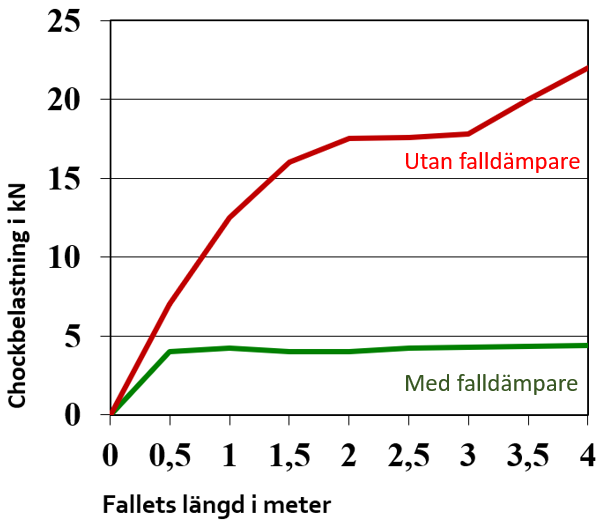
When a fall occurs while using personal fall protection equipment, both the user and the equipment are subjected to significant forces known as shock loading (also referred to as arrest forces). To minimise the risk of injury, the maximum arrest force acting on the user must not exceed 6 kN.
Example: A person weighing 100 kg who falls freely for 1 metre can be subjected to forces of approximately 12 kN (1,200 kg) when using a fall restraint or non-energy-absorbing personal fall protection system. However, when using an energy-absorbing fall arrest system, the system's connecting element incorporates an energy absorber that limits the maximum arrest force to 6 kN while gradually decelerating and stopping the fall.
If the arrest force exceeds 6 kN, the energy absorber must absorb the excess energy to keep the force acting on the user below this limit. It is important to understand that the greater the energy that must be absorbed, the longer the deceleration distance will be.
For this reason, it is essential to consider the required clearance distance. Clearance distance is the minimum safe space below the user that allows the energy-absorbing system to fully deploy, decelerate and stop the fall before the user strikes the ground or any obstacle in the fall path.